Loud, Proud, and Unbowed: The Deeper Meaning of Mexican Noise
Mexican culture embraces ebullience. It is a joyous parade of color and clamor that demands your participation—if only to catch the candy before it hits you in the face. From the wail of mariachi brass and the concussive thrum of the conchero drum to the sting of habanero and the smoke of mezcal, Mexico is vibrant, stimulating, and unapologetically exuberant.
But to know Mexico deeply is to understand that beneath this exuberance lies a heavy history. From the scars of the conquest and colonialism to the pressures of globalism, the veins of hardship run deep. You can hear it in the weeping strings of a mariachi ballad, tucked between the high notes. It is the sound of a people who have learned that if you don’t sing over the sorrow, the sorrow wins.
Yet in Mexico, the call to raise one’s voice runs deeper still; it is the demand for dignity and identity. Indeed, the nation itself was called into existence by a shout — ¨el Grito¨ — that is echoed every year in grand and joyous celebration punctuated by that very cry “¡Viva Mexico!”
But celebration in Mexico is more than political; it is existential. Here the culture of collective joy provides a victory for the soul so total that even Death itself is conquered, overcome in an annual party for the spirits — Dia de Los Muertos — that transforms loss into presence and despair into joy. Only Mexicans would throw a party in a cemetery.
Of course, not all noise in Mexico is festive. Often, it is the hum of commerce or the clang of construction. Together, these sounds form an “acoustic commons”—a shared space where to convivir (to live together) is a naturally noisy act. It is the high whistle of the knife sharpener, the clang that announces the trash truck, the roosters and the roofdogs and the truck speakers blaring recordings on an infinite loop. Even the persistent scrape and strike of a construction site carries gravity. It is the sound of a future—the hopeful percussion of progress.
There is also a profound democracy to Mexico’s noise. In much of the world, silence is a commodity—a luxury bought with high walls, sprawling grounds, and exclusive postcodes. But in Mexico, the soundscape refuses to be gentrified. A cohete does not respect a property line, and a mariachi band doesn’t concern itself with your double-paned windows. Noise is a radical equalizer; it is proof that we all occupy the same space, regardless of the size of our homes or bank accounts. To live in the acoustic commons is to accept that your neighbor’s life is just as significant as your own.
For those of us who have come from other cultures to live in San Miguel de Allende, it is easy to grumble at the volume. Yet, we must consider the price of silence. Here, strict noise ordinances pose a threat to San Miguel’s Economy of Culture. We thrive as a “Pueblo Mágico,” but to sanitize that magic for our own comfort—to quiet the streets—is to risk silencing the workers, artisans, musicians, and tradition-bearers who sustain the soul of this place. The dictum of respect demands a “call to understanding” rather than a demand for silence.
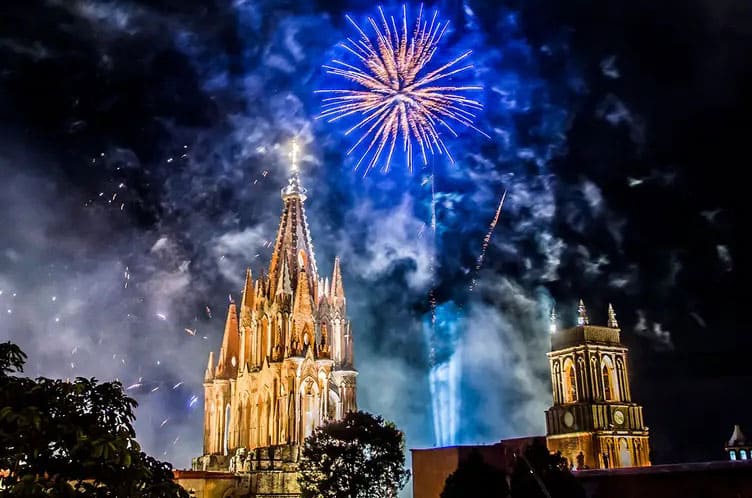
I still find myself startled and rattled by the cohetes. But I try to remember their logic: to the local, they are a jump scare for the Devil and a spiritual telegram declaring to all exactly where the sacred celebration is. They are a cultural declaration of victory — stating that no one can quiet the party.
So, the next time you are startled by the boom of gunpowder, the chorus of roof dogs, or the blare of a passing truck, take a breath and remember where you are. Here silence is surrender, and no power on Earth has ever successfully stopped a Mexican from having a good time. We should consider ourselves lucky to be welcomed into such indomitable joy and celebration.