”Pave it Forward”
I don’t know if San Miguel is “The Best City in the World” — the claim seems preposterous — but I might just argue that San Miguel’s city streets are. Not for the myriad colors and cobblestoned charm for which they are famous, but for the sublime culture of courtesy and cooperation that they instill in the tens of thousands of us that pass through them every day.
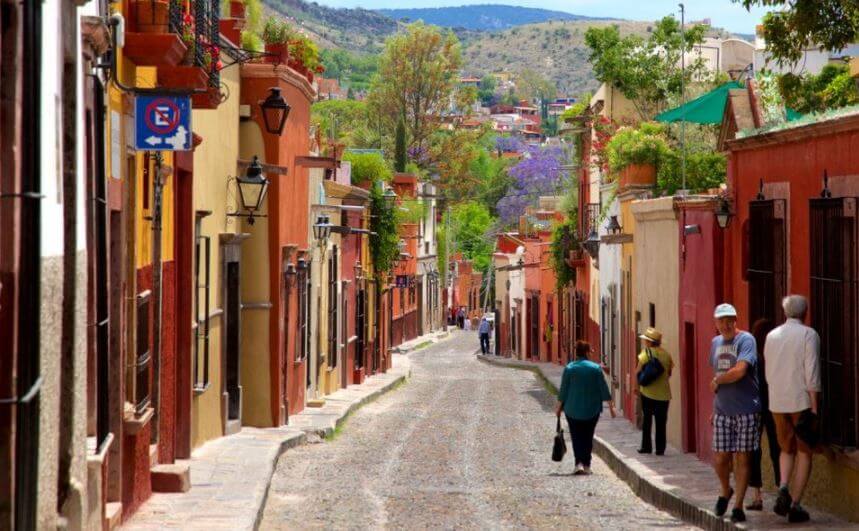
To the uninitiated, the streets of San Miguel de Allende seem like a logistical disaster. Narrow, cobblestoned and uneven — framed by tiny sidewalks and undulating steep hills — the irony of a “walking city” possessing streets that seem impossible to walk on isn’t lost on anyone. But when I think about the human qualities that make our pueblo special—its intimacy, friendliness, diversity, and civic spirit — I am certain our beautiful yet challenging city streets play an essential role in creating them.
Sanmiguelenses might take it for granted, but it’s truly remarkable: we live in a dense urban area of 100,000 people where the city center has not a single stop sign nor stoplight, where no road has the formal right of way, where horns are prohibited, and people generally don’t bother with directional signals. Most streets are one-way, but many are too narrow for passing or parking, so they are frequently and easily blocked. A few of these single-lane streets are even open to two-way traffic (figure that one out!), and a handful are so narrow that wide vehicles can get stuck—something a few visitors in Hummers have discovered only too late.
Then there are the pedestrians, who are everywhere and only growing in number. Ranging from wandering tourists and locals hustling to work, to families with children and expat seniors—not to mention the horses, burros and processions of giant festooned mojiganga effigies, religious devotees, funerals, and wedding parties—these myriads squeeze onto tiny sidewalks, often spilling onto the streets between slow-moving vehicles. Add to this bustling chaos the steep hills and wildly uneven cobblestones (the federally mandated paving), and it seems almost absurd that San Miguel is renowned as a walking town.
And yet, despite all these obstacles, the streets of San Miguel de Allende are nothing less than a stage for a sublime civic order; a world-class dance of urban cooperation.
For drivers, the formal rules are clear. Signs around the city announce the speed limit: 15 km/hour. The remaining rules are presented in eight icons plastered on the back of every public bus. Three are especially notable:
- Drivers take turns at EVERY intersection: “Uno y Uno” (One-by-One).
- Pedestrians ALWAYS have the right of way.
- Honking is PROHIBITED.
These rules are the foundation of an unwritten ethical culture which governs our streets through patience, communication, and courtesy. Because every intersection is a challenge, it requires cooperation to negotiate tight spaces together in turns. Communication is essential, handled through eye contact and hand signals rather than the harsh remonstrance of a horn.
Another challenging feature of driving here is the need to block others on the narrow streets, because unloading anything on these narrow streets requires stopping the traffic behind you. As a result, everyone is enmeshed in a courteous dance of unloading as fast as we can, or waiting as long as we must. We wait because we know that, soon enough, we will need others to wait for us. We pay it forward.
Though not officially mandated, pedestrians follow many of these same rules. The narrow sidewalks demand that we wait or step off to allow others to pass. Here, too, courtesy governs: the young and healthy step aside for the elderly or infirm, and everyone waits for the parades to pass. As pedestrians, our eyes are always in motion: looking down to make sure our steps are sure, up to make eye contact with passersby, and around to capture the singular beauty of this “Pueblo Mágico.”
Whether or not San Miguel’s streets are unique in Mexico, their order follows ethics that any Mexican would recognize: courtesy in public—especially toward the elderly, families, and participants in cultural traditions. In Mexico, people still take the time to say “Buenos días” to anyone they pass in the street.
I worry about the pace of San Miguel’s growth, as each weekend brings more vehicles and crowds. And yet, in the sixteen years I have lived here, the ethical culture of its streets has remained amazingly resilient. It seems that when confronted by our beautiful but challenging terrain, new drivers quickly accept the need for patience. Even those accustomed to aggression are transformed here into more respectful, democratic, and conscious citizens. Our challenging and beautiful streets demand it!